BLOG
Complete Guide to Guided Bison Hunting in Nebraska
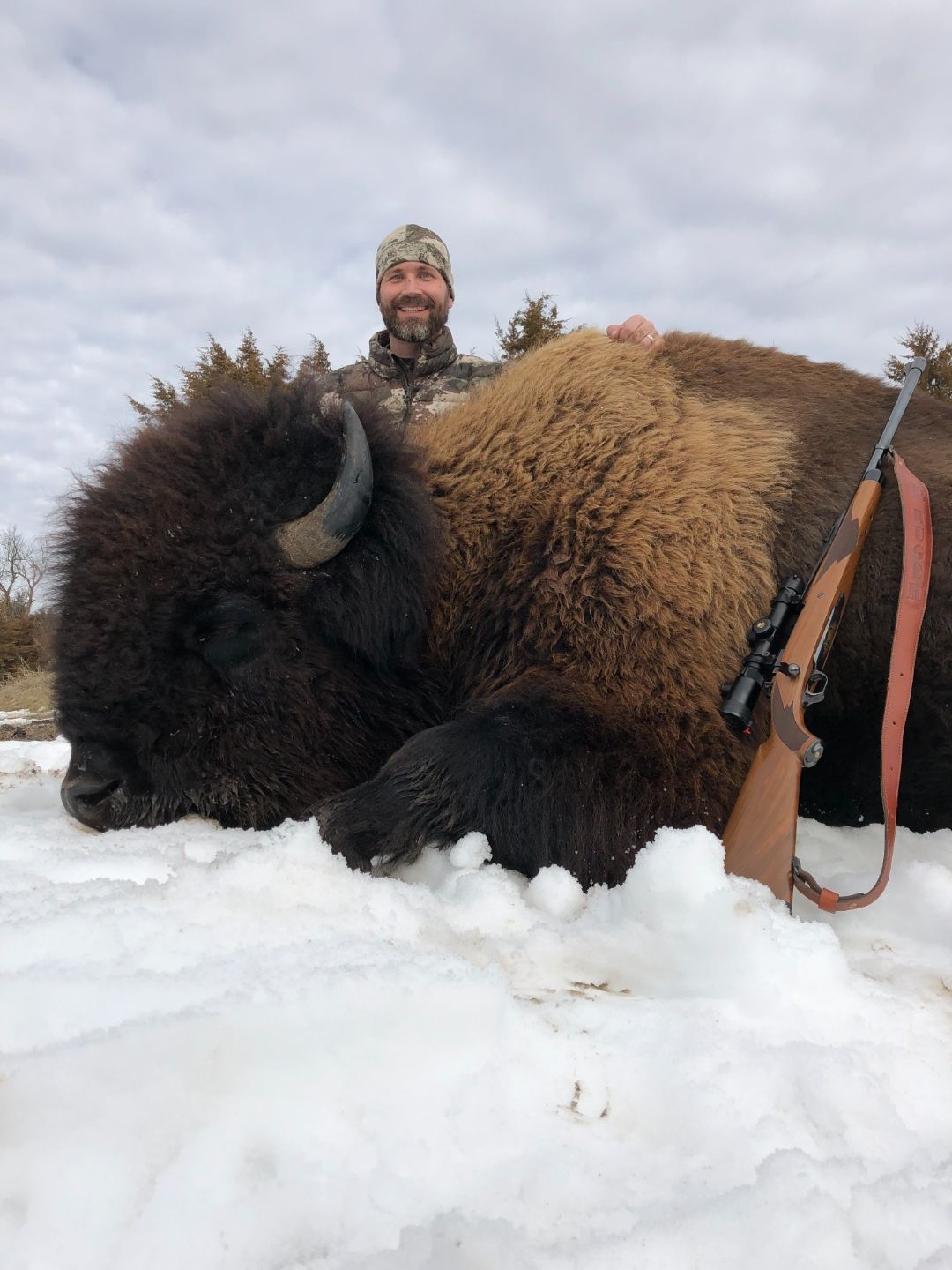
Complete Guide to Guided Bison Hunting in Nebraska
Table of Contents
- Why Hunt Bison in Nebraska
- Nebraska Bison Habitat and the Sandhills
- Spot-and-Stalk Bison Hunting Tactics
- What a Guided Bison Hunt Includes at ReWild Ranch
- Bison Hunt Pricing — What Affects Cost
- Meat Processing — What You Take Home
- Conservation and Ethics of Bison Hunting
- What to Bring and How to Prepare
- Frequently Asked Questions
- Book Your Hunt
Why Hunt Bison in Nebraska
Nebraska is one of the best states in the country for a guided bison hunt — and not just because of the landscape. It comes down to access, legal simplicity, and the sheer number of animals.
The Nebraska Sandhills hold approximately 25,000 bison on private ranches as of 2022. That's not a state-managed lottery. These are privately held herds on working grass-fed operations, which means hunt availability isn't controlled by a draw system. You don't have to wait years to get a tag. You call, you book, you hunt.
That brings up the single most important regulatory fact for anyone researching bison hunting in this state: privately held bison in Nebraska are classified as livestock, not wildlife. The Nebraska Game and Parks Commission has no jurisdiction over them. That means no state hunting license, no permit, no habitat stamp, no tag, and no season restriction. The entire licensing framework that governs deer, elk, and antelope hunting in Nebraska simply does not apply to bison on a private ranch. You can hunt any month of the year.
Compare that to states with draw-only tags. In Utah, a wild bison permit is one of the hardest draws in the country — wait times can run a decade or more. Montana's wild bison hunting is extremely limited and politically contested. Public-land bison tags in most states go to a handful of hunters per year. A private ranch hunt in Nebraska bypasses all of that entirely.
Nebraska also sits in the geographic center of the country. Hunters flying in from either coast deal with comparable travel times. Major airports in Omaha (4 hours) and Grand Island (2.5 hours) serve Sargent, Nebraska, where ReWild Ranch is located. The drive from Denver is under five hours.
Do You Need a Hunting License for Bison in Nebraska?
Nebraska Bison Habitat and the Sandhills
The Nebraska Sandhills cover roughly 19,300 square miles of north-central Nebraska — rolling, grass-stabilized sand dunes underlaid by shallow groundwater from the Ogallala Aquifer. The dunes themselves are ancient; the grasses holding them in place have been there for thousands of years. This is the largest grass-stabilized dune system in the Western Hemisphere and the most intact remaining mixed-grass and tallgrass prairie on the continent.
Bison didn't just pass through here. They evolved here. The native grass species — big bluestem, switchgrass, sand lovegrass, needle-and-thread, prairie junegrass — are exactly what bison are built to convert into muscle and fat. No other grazing animal uses the Sandhills vegetation as efficiently as a bison. They select different forage than cattle, consume more grass with less impact on the forb layer, and their wallowing and grazing patterns actively maintain the prairie ecosystem.
The terrain shapes how hunting plays out. The Sandhills aren't flat. You have rolling dune topography with ridgelines, draws, and wide-open meadows between them. Good glassing is possible from high points, and the draws provide cover for stalking. A typical spot-and-stalk approach on a Sandhills hunt uses the ridges to locate the herd from a distance, then the draws to approach. That's not mountain terrain — you're not climbing at altitude — but it rewards hunters who understand how to use elevation and wind.
Sandhills weather is honest about what it is. Summers are hot and dry; highs in July and August frequently reach the upper 90s. Spring and fall bring variable conditions — warm afternoons and cold mornings are normal through October. Winter sets in hard in November and can run through March with temperatures well below zero and open-range wind that matters. Every season has its advantages, which we cover in the gear and preparation section below.
Fort Niobrara National Wildlife Refuge near Valentine, Nebraska — about 90 miles north of Sargent — is part of why Nebraska's bison story runs deep. It was established in the early 1900s as one of only three original federal reserves created specifically to prevent bison extinction. The animals protected and bred at Fort Niobrara are part of why Nebraska's Sandhills have bison today.
When you hunt a bison in the Nebraska Sandhills, you're hunting on the landscape where the recovery started.
Nebraska Sandhills Wildlife Guide
Spot-and-Stalk Bison Hunting Tactics
A guided bison hunt on a working ranch doesn't look like a pen hunt, and it doesn't look like deer hunting. Bison operate in herds on open ground. The challenge isn't necessarily finding them — it's getting close enough for a clean, ethical shot.
At ReWild Ranch, we use a spot-and-stalk approach. We glass from elevated ground in the morning and evening when animals are feeding and moving. Once we've located the herd, we read the wind, plan a route using terrain features — usually draws and low ground — and work toward a position within 100 yards. Closer is better with bison. The kill zone is large, but you want margin for error on a 1,500-pound animal.
Shot placement is critical. Here's what actually works and what doesn't:
The correct shot is a double-lung broadside. Aim just above the front leg at roughly one-third up from the bottom of the body — that puts your bullet through both lungs. That's the shot. It produces a fast, clean kill even on large bulls.
What to avoid: Do not aim for the head. A bison's frontal skull bone is several inches of dense bone, and bullets have deflected off bison skulls. Do not aim for the neck — it's thick and short, and getting a reliable spinal shot requires precision that's hard to guarantee at any distance. Do not aim high on the shoulder hump. That's mostly muscle mass; the vitals sit lower than most hunters expect.
After a well-placed double-lung shot, a bison will typically run 50–100 yards and go down. They do not always drop immediately the way a deer might. Keep your cool, hold your position, and wait. Do not fire into the herd. If the animal rejoins the group, wait for separation before taking a follow-up shot.
On caliber: The minimum we recommend is a .300 Win Mag with heavy-for-caliber bullets. We see a lot of .338 Win Mag and .375 H&H on these hunts, and both are well-suited. The key isn't just energy — it's bullet construction. Use bonded or controlled-expansion bullets that maintain integrity through heavy muscle and bone. Standard hunting rounds that perform fine on deer or elk may not perform adequately on a mature bison bull. A 200-grain or heavier projectile in .300 Win Mag, or equivalent in .338 or .375, will do the job.
Muzzleloaders are legal on our hunts (minimum .54 caliber, or .45 caliber with a 300-grain bullet minimum). We also allow large-bore pistols (.44 Mag minimum). Archery hunts require a minimum 50-pound draw weight with arrows weighing at least 300 grains total.
The final approach on a ReWild hunt typically covers terrain on foot. We'll use a UTV or truck to get into position, but the last stalk — the last 200 to 400 yards — is on the ground with your rifle. That's where the hunting is.
Bison Hunting Caliber Guide
What a Guided Bison Hunt Includes at ReWild Ranch
The hunt is priced at $6,200, and that number is all-in. Here's what's covered.
Day 1 — Arrival:
Hunters arrive at ReWild Ranch in Sargent, Nebraska and check into the lodge. The main lodge is 8,500 square feet with private guest rooms. You'll have dinner that evening — farm-to-table cooking using ranch-raised bison along with other ingredients sourced from the operation. The evening is relaxed: no early alarm, no scramble. Your guide will walk through the next morning's plan.
Day 2 — The Hunt:
You're up before light. The guide loads the UTV and gets you onto the property in position before the herd starts moving. We glass from the high ground, read the wind, and make our move. Most hunts produce an opportunity in the first morning. Once the animal is down, field dressing happens on-site. That means the guide does the heavy work: gutting, skinning, and quartering the animal in the field. Quarters go directly onto the UTV and then into our walk-in cooler.
Day 2 Afternoon / Day 3 — Processing:
The animal hangs and cools. Our on-site butcher shop handles the cutting to your specifications. Standard cuts include ground bison, chuck roasts, inside and outside round roasts, strip-loin steaks, prime rib, stew meat, and tenderloin. We vacuum-seal and flash-freeze everything. Custom add-ons — jerky, marinated cuts, sausage — are available. You leave with labeled, packaged, frozen meat ready for transport home.
Day 3 — Departure:
Load your coolers, shake hands, and head out. Most hunters are on the road or at the airport by midday.
Non-hunter guests: Spouses, kids, and friends who aren't hunting are welcome at the lodge at $150 per day. The ranch property, the lodge itself, and the farm-to-table meals are a legitimate destination even for non-hunters. We've had groups where one person hunts and three others spend the days on the property, eating well, and relaxing. The lodge accommodates it.
What the $6,200 covers:
- 2 hunting days
- 3 nights lodging
- All meals during your stay
- Professional guide service
- Field dressing and processing (on-site butcher shop)
- Vacuum sealing and flash freezing
- UTV field transportation
What you're responsible for: getting to Sargent, Nebraska; your own firearm and ammunition; and coolers for transport. Plan for three large coolers for meat.
What to Expect on Your First Bison Hunt
Bison Hunt Pricing — What Affects Cost
The national range for guided bison hunts runs from roughly $3,000 on the low end to $26,000 for record-class trophy bulls. Understanding what's actually in each price point matters before making a comparison.
$3,000–$4,500: Budget cow or yearling hunts, usually in South Dakota or Oklahoma. At this price, look closely at what's excluded. Northern Plains Outfitters in South Dakota charges $150 just to skin the animal, and full processing is not included. No Mercy Hunting in Oklahoma at $3,500 for a cow doesn't include game care. By the time you add $250–$1,000 for processing and $450–$750 per night for lodging over two or three nights, many of these hunts land at $5,000–$6,500 anyway.
$4,500–$6,500: True all-inclusive meat hunts. This is where ReWild Ranch sits at $6,200. Worldwide Trophy Adventures offers a Nebraska cow bison option at $5,500, but that excludes the on-site processing ($1,000 additional). Jim River Guide Service in South Dakota offers cows at $3,600 and meat bulls at $5,600, all-inclusive.
$6,500–$12,000+: Trophy bull hunts based on horn size and age. These target mature bulls at 1,500–2,000 lbs, often with trophy fees layered on. The Worldwide Trophy Adventures Nebraska Sandhills trophy bull hunt runs $12,000, with processing additional. ReWild Ranch is not competing in this category — we're a meat hunt, not a trophy operation.
The value math on $6,200:
- 250–350 lbs of grass-fed bison meat at retail ($12–$25/lb depending on cut) = $3,000–$7,500 in meat value
- 3 nights in an 8,500 sq ft lodge with meals included = $600–$900 equivalent
- On-site butchering and vacuum packing = $500–$1,000 at a commercial processor
- Experienced guide service
The experience covers itself when you run the actual numbers. The $6,200 gets you a clean, straightforward package with no add-on surprises.
Bull vs. cow pricing: Some outfitters charge differently for bulls versus cows. At ReWild Ranch, we focus on meat hunts and price accordingly. What you're selecting is the total experience and the yield of grass-fed protein, not a trophy class.
Meat Processing — What You Take Home
Meat yield is the most misunderstood part of booking a bison hunt. We want to be straight with you here, because some outfitters aren't.
The yield math, honestly:
A 1,100-pound live bull produces approximately 616 pounds of hanging weight (56% of live weight). After removing fat, bone, and waste, you end up with roughly 464 pounds of packaged meat. That's from a full-grown bull north of 1,000 pounds live.
An 800-pound young bull — the kind of animal many "budget" meat hunts are built around — yields approximately 450 pounds hanging weight and 225–250 pounds of packaged meat. Not 400–500 pounds. When you hear "400–500 pounds of meat" from a competitor offering a young yearling hunt, that number doesn't hold up against the research data from the Canadian Bison Association, which is the most thorough yield study available. The 400–500 lb claim requires a mature bull well above 1,200 lbs live weight.
Our honest estimate at ReWild Ranch is 250–350 pounds of packaged meat. That's what typical ranch bison hunts produce, and it's what our processing reflects.
What those 250–350 pounds look like in cuts:
Based on a mid-size bull:
- Ground bison (trim): the largest category, typically 35–40% of total packaged weight — roughly 90–140 lbs
- Chuck and cross-rib roasts: 60–75 lbs
- Inside and outside round roasts: 50–65 lbs
- Strip-loin steaks: 20–25 lbs
- Prime rib steak/roast: 20–25 lbs
- Tenderloin steaks: 8–10 lbs
- Stew meat: 18–22 lbs
- Short ribs and specialty cuts: 15–20 lbs
You're not getting a beef-style butcher breakdown with a thick fat cap on everything. Bison is naturally lean. Ground bison from a grass-fed ranch animal will run 90–93% lean. Your steaks won't have heavy marbling — they'll have clean muscle fiber with good flavor.
Processing at ReWild Ranch:
The sequence after a successful hunt: field dressing on-site (guides handle this), skinning and quartering, transport to the walk-in cooler, a cooling period of 24–48 hours, then custom butchering and vacuum packaging in our on-site butcher shop. We flash-freeze everything before you leave. All of this is included in the $6,200 price. You are not getting a bill at the end for processing.
For transport home, plan on three large coolers for a standard meat hunt. If you're driving, a truck bed chest freezer is ideal for a long haul. If you're flying, most commercial carriers will accept frozen meat checked as baggage — pack it tightly in a foam cooler with dry ice, declare it properly, and it travels fine on most routes.
The nutritional case for bison:
Per 100 grams, bison comes in at 2.2 grams of fat, 148 calories, and 61 mg of cholesterol. Beef sits at 6.5 grams of fat, 180 calories, and 72 mg of cholesterol. Chicken — commonly held up as the lean protein standard — runs 7.4 grams of fat at 167 calories per 100 grams. Grass-fed bison beats all three. The omega-3 to omega-6 ratio is also favorable compared to grain-fed beef. If you're filling a freezer with protein for a year, you're filling it with something worth eating.
How Much Meat Do You Get from a Bison Hunt?
Conservation and Ethics of Bison Hunting
Bison hunting in 2025 sits in a complicated historical context. Understanding it honestly is part of being a responsible hunter.
Where the population stood:
Before European commercial expansion, an estimated 30–60 million bison roamed North America from Mexico north into Canada. By 1884, that number had fallen to roughly 325 animals. By 1889, only 541 remained on the entire continent. The collapse happened in a matter of decades, driven by commercial hide hunting, railroad expansion, and deliberate government policy aimed at eliminating the food supply of Plains tribes. It's one of the most dramatic wildlife collapses in recorded history.
Recovery started slowly and deliberately. Fort Niobrara National Wildlife Refuge, established in the early 1900s near Valentine, Nebraska, was one of only three original federal reserves created specifically to keep bison from going completely extinct. The animals protected and bred at Fort Niobrara are part of why Nebraska's Sandhills have bison today.
By 2017, total North American bison numbers had reached approximately 500,000, with roughly 30,000 in wild or conservation herds and the remainder in commercial and ranch operations. Nebraska ranked second nationally in bison population as of 2022, with 32,206 animals — trailing only South Dakota's 33,995. In 2023, the Department of the Interior committed $25 million from the Inflation Reduction Act to bison restoration, including tribal herd establishment. In November 2024, the U.S., Canada, and Mexico signed a Letter of Intent to strengthen cooperative bison conservation across the continent.
Despite the population recovery, bison are still considered ecologically extinct across most of their historic range. They occupy less than 1% of the territory they once roamed. Most herds are small, fenced, and genetically isolated. A species that once numbered 60 million and functioned as the keystone of the Great Plains ecosystem now exists primarily in managed pockets. True ecological recovery — herds of thousands in free-ranging country — is still an unfinished project.
Where ranch hunting fits into that picture:
Private ranch herds need management. A bison herd on a fixed acreage will exceed carrying capacity without culling. The alternatives to guided hunting are commercial slaughter or letting the herd degrade. A guided hunting program converts a necessary management activity into a revenue-positive experience that also keeps the rancher economically incentivized to maintain the herd and preserve native grass acres.
The Nebraska Sandhills hold approximately 25,000 bison on private ranches — that's 25,000 animals on millions of acres of native prairie that might otherwise convert to row-crop agriculture. The economic model that sustains those herds depends in part on hunters. Take away the hunting revenue and you weaken the case for ranchers to keep bison at all.
The ethics of the harvest itself are also worth stating plainly. A bison on our ranch lives on native Sandhills grass its entire life. It has space, it behaves naturally, and it dies with a single well-placed rifle shot on the ground where it's spent its whole life. Compare that to a commercially slaughtered bison raised in a feedlot or trucked to a processing facility. The hunted animal has it better by any honest measure.
We use all of it. The hunter takes 250–350 pounds of meat. ReWild Ranch retains the bones, organs, and hide for use on the ranch. Nothing is wasted.
Bison Conservation and Hunting Ethics
What to Bring and How to Prepare
A bison hunt at ReWild Ranch is physically manageable for most hunters in reasonable health. This isn't a mountain hunt. There's no elevation gain, no multi-day backpack, no extreme cold camping. That said, some preparation makes the trip better.
Physical preparation:
Plan to walk on uneven ground. The Sandhills terrain is rolling — you'll move through draws and over dune ridges. Most of the work on a given hunt involves a few miles of walking total, with extended periods of standing and glassing. If you can walk a couple of miles in boots without stopping, you're prepared. We do have UTV access for hunters with mobility limitations, and the final approach on foot can often be kept short with good planning.
Your rifle and ammunition:
Minimum recommendation is a .300 Win Mag with heavy-for-caliber, bonded or controlled-expansion bullets. Bring a rifle you shoot well at 100 yards. A 200-grain load in .300 Win Mag is a solid baseline. If you're running .338 Win Mag or .375 H&H, even better. Zero your rifle at 50 yards — most shots on a guided ranch hunt are inside 150 yards.
Bring at least 20 rounds. You'll use far fewer, but bring the box.
Optics:
A quality 10x binocular is the most important piece of gear outside your rifle. We do the glassing, but you want your own binocular for verification and for the approach. A rifle scope in the 4–12x range handles every situation you'll encounter on a Sandhills hunt. Higher magnification than that is unnecessary.
Clothing and layers:
Nebraska weather varies significantly by season. For summer hunts (June–August), plan for hot afternoons and cooler mornings. Lightweight moisture-wicking layers, a hat with a brim, and good sun protection. For fall (September–November), layering is essential — you may start in a heavy jacket at dawn and shed it by 10 a.m. For winter hunts (December–March), dress for wind. The Sandhills are exposed country and north wind at 20 mph below freezing cuts through unprepared hunters quickly. A quality insulated base layer, mid-layer, and wind-stopping outer layer are non-negotiable.
Boots:
Bring boots you've already broken in. Full-grain leather or quality synthetic hunting boots with ankle support. The sand and grass of the Sandhills doesn't require extreme technical boots — medium-duty hunting boots are fine. Gaiters are useful in fall and winter when grass seed and burrs are present.
Travel logistics:
The nearest major airports are Grand Island Regional (GRI), approximately 2.5 hours southeast of Sargent, and Omaha Eppley (OMA), approximately 4 hours east. Denver International (DEN) is under 5 hours by car and is a practical option for hunters flying from the West. We're happy to help coordinate logistics once you've booked.
What the ranch provides:
Everything related to the hunt itself — guide service, UTV transportation, field care of the animal, butchering, vacuum sealing, and freezing. The lodge provides all meals and your sleeping accommodations. You're not bringing food or camp gear.
What you bring:
- Your rifle, ammunition, and optics
- Clothing appropriate for the season
- Coolers for meat transport (three large coolers minimum)
- Any personal medications, toiletries, and gear
- Tags or licenses? None required for a private bison hunt in Nebraska.
Best time of year:
There's no bad time to hunt at ReWild Ranch, since we operate year-round. Each season has advantages. August produces bison at peak summer condition on lush grass — best overall meat quality. October through January gives you the thickest winter coats, which matters if you want a robe or a mount. Spring hunts (April–June) offer pleasant weather and active herds before the heat sets in. Winter hunting has its own character — quiet, cold, and dramatic in the Sandhills.
Planning Your Nebraska Hunting Trip
Frequently Asked Questions
1. How much does a guided bison hunt cost at ReWild Ranch?
The hunt is $6,200, all-inclusive. That covers two hunting days, three nights in the lodge, all meals, professional guide service, field care of the animal, and complete custom butchering with vacuum packing and flash freezing. There are no add-on fees for processing. Non-hunting guests can accompany hunters at $150 per person per day and have full access to the lodge and meals.
2. Do I need a hunting license to hunt bison in Nebraska?
No. Privately held bison in Nebraska are classified as livestock, not wildlife. The Nebraska Game and Parks Commission hunting regulations — licenses, permits, habitat stamps, season dates, bag limits — apply to wild game species like deer, elk, and antelope. None of those rules apply to bison on a private ranch. You do not need a Nebraska hunting license, a non-resident tag, a habitat stamp, or any other state-issued permit to hunt bison at ReWild Ranch. There are no season restrictions, either.
3. How much meat will I take home from a bison hunt?
Our honest estimate is 250–350 pounds of packaged, vacuum-sealed, frozen meat. This is based on the actual yield math: bison produce roughly 56% hanging weight from live weight, and then roughly 75% of hanging weight as packaged meat after trimming bone and fat. A full mature bull at 1,100 lbs yields about 464 lbs of packaged meat; the animals on most ranch meat hunts are smaller, producing 250–350 lbs. Competitors who quote 400–500 lbs for young bulls or heifers are overstating actual yield.
4. What caliber rifle do I need for bison?
Minimum recommended caliber is .300 Win Mag with a heavy-for-caliber bonded bullet (200 grains or heavier). Common calibers on our hunts include .338 Win Mag and .375 H&H. The key is bullet construction — use a bonded or controlled-expansion projectile that will hold together through heavy muscle and bone. Standard deer-hunting bullets are not appropriate. We also allow muzzleloaders (.54 caliber or larger), large-bore pistols (.44 Mag minimum), and archery tackle meeting minimum specifications. Zero your rifle at 50 yards; most shots are inside 150 yards.
5. How physically demanding is a bison hunt?
Less demanding than most big game hunts, but not a ride-along. You'll cover uneven terrain — rolling sand dunes, draws, and grassland — on foot for the final stalk, and extended time on your feet glassing. Most days involve a few miles of walking total. If you're in reasonable health and can walk a couple of miles in boots, you'll handle this hunt fine. We use UTVs for field access and for hunters with mobility limitations. This is accessible to older hunters and those with moderate physical restrictions in a way that mountain hunts are not.
6. What's included in the $6,200 hunt package?
The price covers: two days of guided hunting, three nights of lodging in the 8,500 sq ft ranch lodge (private rooms), all meals including farm-to-table dinners featuring ranch-raised bison, professional guide service, field dressing of the animal after harvest, on-site butchering to your cut specifications, vacuum sealing, and flash freezing. It does not include travel to the ranch, your firearms and ammunition, or coolers for transport home. No Nebraska hunting license or permit is required.
7. Can non-hunters come along and stay at the lodge?
Yes. Non-hunting guests are welcome at $150 per person per day. They have full access to the lodge, all meals, and the ranch property. Many hunters bring a spouse, adult children, or friends who enjoy the ranch experience without hunting. The lodge accommodates groups comfortably — it's 8,500 square feet with private guest rooms.
8. When is the best time of year for a bison hunt in Nebraska?
ReWild Ranch operates year-round, which is a significant advantage over competitors who are seasonal (typically December through February only). Each season has a different character. Late summer (August) produces bison at peak grass-fed condition after months of summer grazing — best overall meat quality. October through January yields the thickest winter coats, which is relevant if you want a hide, robe, or mount. Spring hunts (April through early June) offer mild weather before the heat of summer. Winter hunts are cold and dramatic — the Sandhills have their own feel in January. There is no wrong time to hunt here.
Book Your Hunt
If you're ready to book, or if you have questions before committing, call or text Danielle directly. She handles all bookings for ReWild Ranch and can walk you through dates, availability, and logistics.
A typical hunt runs three nights and two full hunting days. You leave with 250–350 pounds of grass-fed bison — vacuum sealed, flash frozen, and processed to your specifications in our on-site butcher shop. The $6,200 price covers everything from arrival to cooler loading, with no processing bills waiting at the end.
The lodge is in Sargent, Nebraska, in the heart of the Sandhills. Drive in or fly into Grand Island or Omaha and rent a car. We'll take care of everything else.
Call or text Danielle to check available dates and book your hunt: rewildranch.com
ReWild Ranch — Sargent, Nebraska. Guided bison hunts on 500 acres of native Sandhills prairie. Year-round availability. No license required. $6,200 all-inclusive.
check out other posts
Nebraska Sandhills Lodge: Where to Stay When You're Not Hunting
Buffalo Hunts: What a Real Guided Hunt Looks Like in 2026
