BLOG
How Much Does an Aoudad Hunt Cost? A Full Price Breakdown
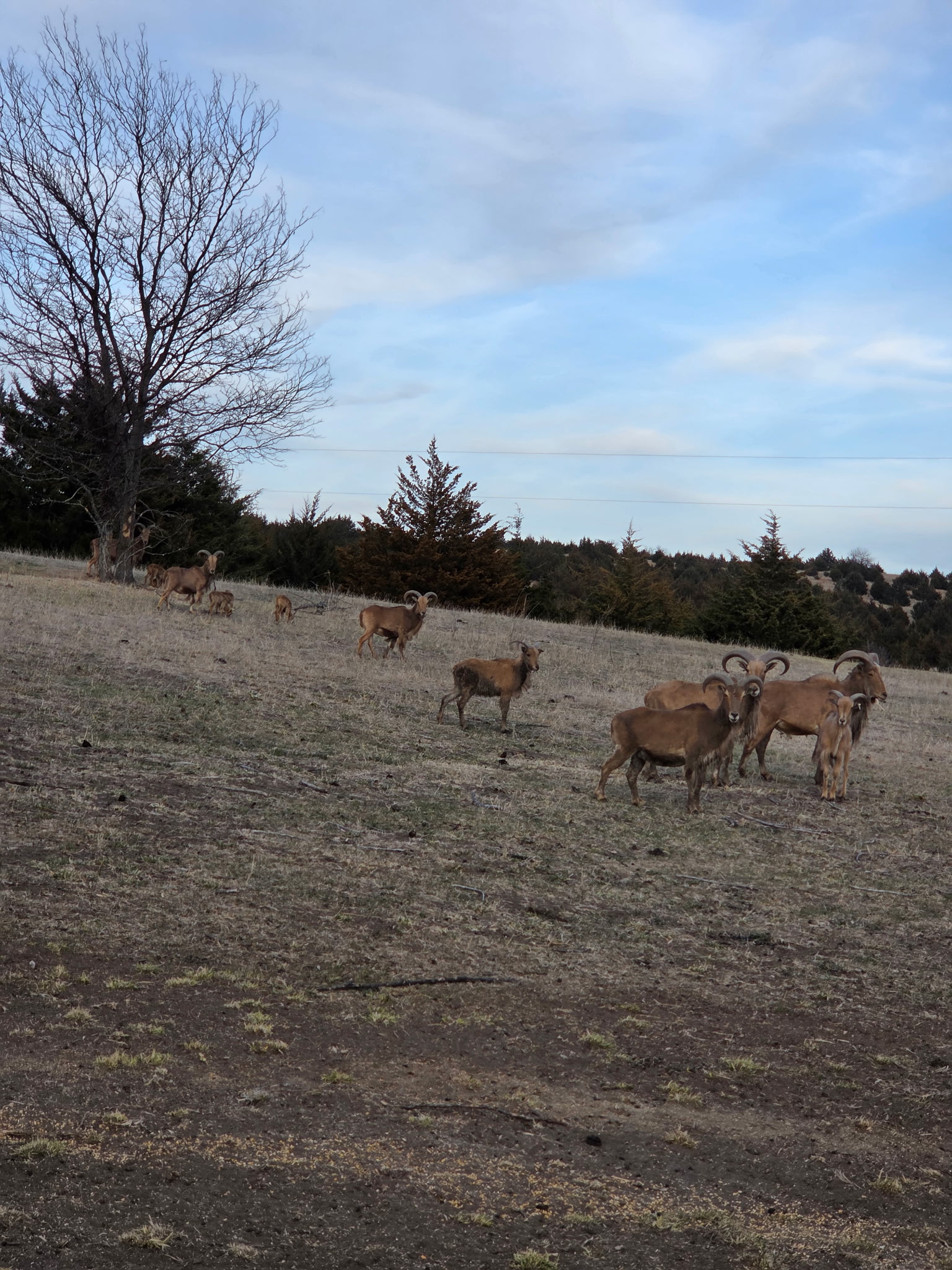
If you're pricing out an aoudad hunt and feeling like you can't get a straight answer, you're not imagining it. Most outfitters make you call for a quote. Some post a trophy fee but bury the day rate, the processing fee, and the extras in the fine print. Others bundle everything and make it look expensive on the surface when it's actually cheaper once you do the math.
I'm going to walk through exactly what a guided aoudad hunt costs — the national range, what's driving Texas prices to where they are, what gets left off the invoice until you've already booked your flights, and how our all-inclusive model here in Nebraska actually stacks up when you run the numbers honestly.
The National Price Range
Guided aoudad hunts in the United States run from roughly $2,500 on the low end to $7,000 and up on the high end. That spread is real, and it's not arbitrary — it reflects meaningful differences in terrain, trophy quality, lodge quality, herd management, and hunt structure.
A $2,500 hunt is typically a high-fence operation with an ewe or a younger ram. A $7,000+ hunt is usually a multi-day, free-range spot-and-stalk in West Texas mountain country where you might be glassing miles of rugged terrain at 5,000 feet.
Most of the quality guided hunts land in the $4,500–$6,500 range when you add everything up. Key word: when you add everything up. Which most hunters don't do until they're already committed.
How Texas Outfitters Price Their Hunts
Texas dominates the aoudad hunting market, so it's worth understanding how their pricing structure works — because it's different from what most hunters are used to.
The standard Texas model has two or three components:
Trophy fee: This is what you pay for the animal itself. For a shootable ram, trophy fees at reputable Texas operations typically run $3,950 to $5,500. Some operations tier their fees by horn size — $3,950 for a ram under 29 inches, $4,950 or more for a 30-inch-plus trophy. The ewe price is much lower, typically around $1,000, which is why ewe hunts are popular with budget hunters who just want meat.
Day rate / nightly lodging: On top of the trophy fee, most Texas operations charge a day rate. This covers your guide, lodging, and sometimes meals — though "sometimes" is doing a lot of work in that sentence. Day rates at Texas outfitters run $250 to $750 per night, depending on lodge quality and whether meals are included. A typical 3- or 4-day hunt adds $750 to $3,000 to your total depending on where you're staying.
Field processing: When your ram hits the ground, someone has to skin it, cape it, and get the meat cooled and packaged. At many Texas operations, that's a separate fee. Expect to pay $150 to $400 depending on whether you want the hide salted and the cape prepped for a taxidermist. Some outfitters include this; many don't.
When you add those three items together, a typical guided Texas aoudad hunt comes out to $5,000–$8,000 before you've booked a single flight.
Here's a real-world example using publicly available pricing from Rock Creek Ranch in Texas: trophy fee of $5,000 for a ram, plus $450 per night for lodging. A 3-night hunt puts you at $6,350 before processing, taxidermy, and travel.
The Costs Most Hunters Miss
This is where the real sticker shock happens, and it's worth spelling out specifically.
Getting to West Texas is not cheap. El Paso and Midland are the gateway airports for Trans-Pecos aoudad country. Depending on where you're flying from, you're looking at $400–$1,200 in flights, plus a rental truck or SUV for at least 3–4 days. Gas, tolls, and a night in a hotel before the hunt starts are all standard. Budget $1,000–$2,500 for travel to West Texas from anywhere east of the Mississippi.
Meals may not be included. This sounds minor, but three days of eating in West Texas — if your outfitter doesn't include meals — can run another $200–$400. Read the fine print.
Taxidermy is a real number. A shoulder mount on a ram is not cheap. Quality work at a good taxidermist runs $500–$800. A full-body mount can push $2,500. That's your trophy, not a frivolous expense — but it needs to be in the budget.
Extra nights. Aoudad hunting is weather-dependent and animal-dependent. If conditions are tough and you don't connect on day 3, you need another night. At $450–$750 per night, that's real money. Some outfitters offer a hunt extension at a discount; many charge full rate.
Shipping or driving the trophy home. If you flew in, your cape and horns need to get back to you. Overnight shipping for a prepared cape and skull is typically $100–$250.
Add those extras to a mid-range Texas hunt and it's not unusual to spend $8,000–$10,000 all-in for a guided Texas aoudad hunt when you're honest about every line item.
What Drives the Price Up (or Down)
Several factors move the needle significantly:
Trophy size: The most obvious variable. Larger-horned rams cost more in trophy-fee-based operations. A 35-inch-plus ram might carry a $6,000–$8,000 trophy fee at a premium operation. If horn size doesn't matter to you and you want meat, a younger ram or an ewe will cut your costs nearly in half.
Free-range vs. high-fence: Free-range aoudad hunts in West Texas carry a premium because you're hunting truly wild animals across large chunks of mountain terrain. High-fence hunts are often marketed as "fair chase" — and they can be on large properties — but the pricing is usually lower. The experience is legitimately different. Know which one you're booking.
Hunt duration: A 2-day hunt costs less than a 5-day hunt. Most quality aoudad hunts are 3–4 days. Shorter hunts mean more pressure on both hunter and guide to put you on an animal quickly; longer hunts give you time to be selective.
Lodge quality: Some Texas aoudad operations are working ranches with basic bunkhouse accommodations. Others are full-service lodges with real beds, hot food, and a bar. The price difference between those two experiences can be $500–$1,500 over a hunt.
1x1 vs. 2x1 guiding: A private 1x1 guide costs more than a 2-on-1 arrangement. For a species where spot-and-stalk is the primary method and you may be covering miles in a day, a dedicated 1x1 guide matters. Ask before you book.
How the All-Inclusive Nebraska Model Works
Here at ReWild Ranch, we price our hunts differently. One number covers your lodging in our 8,500-square-foot lodge, all your meals (farm-to-table, not sandwiches in a truck), your guide, and field processing of your animal. You know what you're paying before you confirm the trip.
The Sandhills terrain we hunt is different from West Texas — rolling grass-stabilized dunes instead of 6,000-foot shale mountains. That means the hunt is accessible to a wider range of hunters. No altitude to acclimate to, no sharp rock terrain, no need to fly into El Paso and rent a truck. Most of our hunters drive in, which cuts travel costs dramatically.
Nebraska also sits closer to the population centers in the Midwest, the Great Plains, and the mid-Atlantic. If you're coming from Iowa, Minnesota, Missouri, Illinois, or anywhere in between, you might be driving 6–8 hours instead of coordinating two flights.
INTERNAL LINK: Aoudad Hunting in Nebraska: Why Hunters Are Skipping Texas
The Meat Value You're Taking Home
This doesn't show up on anyone's cost comparison, but it should. A mature aoudad ram dressed out yields roughly 80 to 130 pounds of meat — sometimes more. Based on yields from field reports, two rams process down to approximately 160 pounds of usable meat between them, including around 120 pounds of sausage-quality ground, 30 pounds of roasts, and 10 pounds of backstrap.
At retail prices for quality game sausage — $8 to $12 per pound — that meat has real monetary value. It's not the reason to book the hunt, but it's worth noting when you're comparing the true cost of the trip against what you bring home.
What You Should Ask Every Outfitter Before Booking
Before you put a deposit down anywhere, get clear answers on these three things:
- Is the trophy fee the only per-animal charge, or are there add-ons (processing, caping, shipping)?
- Are meals and lodging included, or do those have a separate daily rate?
- What happens if I hunt my full days and don't connect — is there an extension option and what does it cost?
Any outfitter who hesitates on those questions or can't give you a direct answer is telling you something.
Frequently Asked Questions
Q: What's the cheapest way to book a guided aoudad hunt?
The lowest-cost path to a guided aoudad hunt is an ewe tag or a younger ram at a high-fence operation — typically $2,500–$3,500 all-in. If your goal is meat and experience rather than a specific trophy, this is a legitimate option. Free-range hunts for mature rams will almost always run $5,000 and up when you count everything.
Q: Do I need a hunting license for an aoudad hunt in Texas?
Yes. Texas requires a non-resident 5-day special hunting license — Type 157 — which runs approximately $48 and is available at Walmart and most sporting goods stores near the ranch. No tag or draw permit is required for private-land exotic animals like aoudad. In Nebraska, no state hunting license is required for privately owned exotic species on private land.
Q: Is it worth paying more for a free-range hunt vs. a high-fence operation?
That depends on what you want out of the experience. Free-range aoudad hunting in West Texas mountain terrain is a physically demanding, multi-day spot-and-stalk hunt that challenges you the same way a mountain elk hunt does. High-fence operations can still be large properties with genuine hunting, but the dynamic is different. If you're after a mount and a good story, you'll want to be honest with yourself about which experience you're actually buying.
Ready to talk through a Nebraska aoudad hunt? Contact Danielle at ReWild Ranch to get specific details on availability, pricing, and what our all-inclusive package covers. Reach us at rewildranch.com or call (308) 730-4116.
check out other posts
Nebraska Sandhills Lodge: Where to Stay When You're Not Hunting
Buffalo Hunts: What a Real Guided Hunt Looks Like in 2026
