BLOG
Aoudad Hunting in Nebraska vs Texas: Where Should You Book?
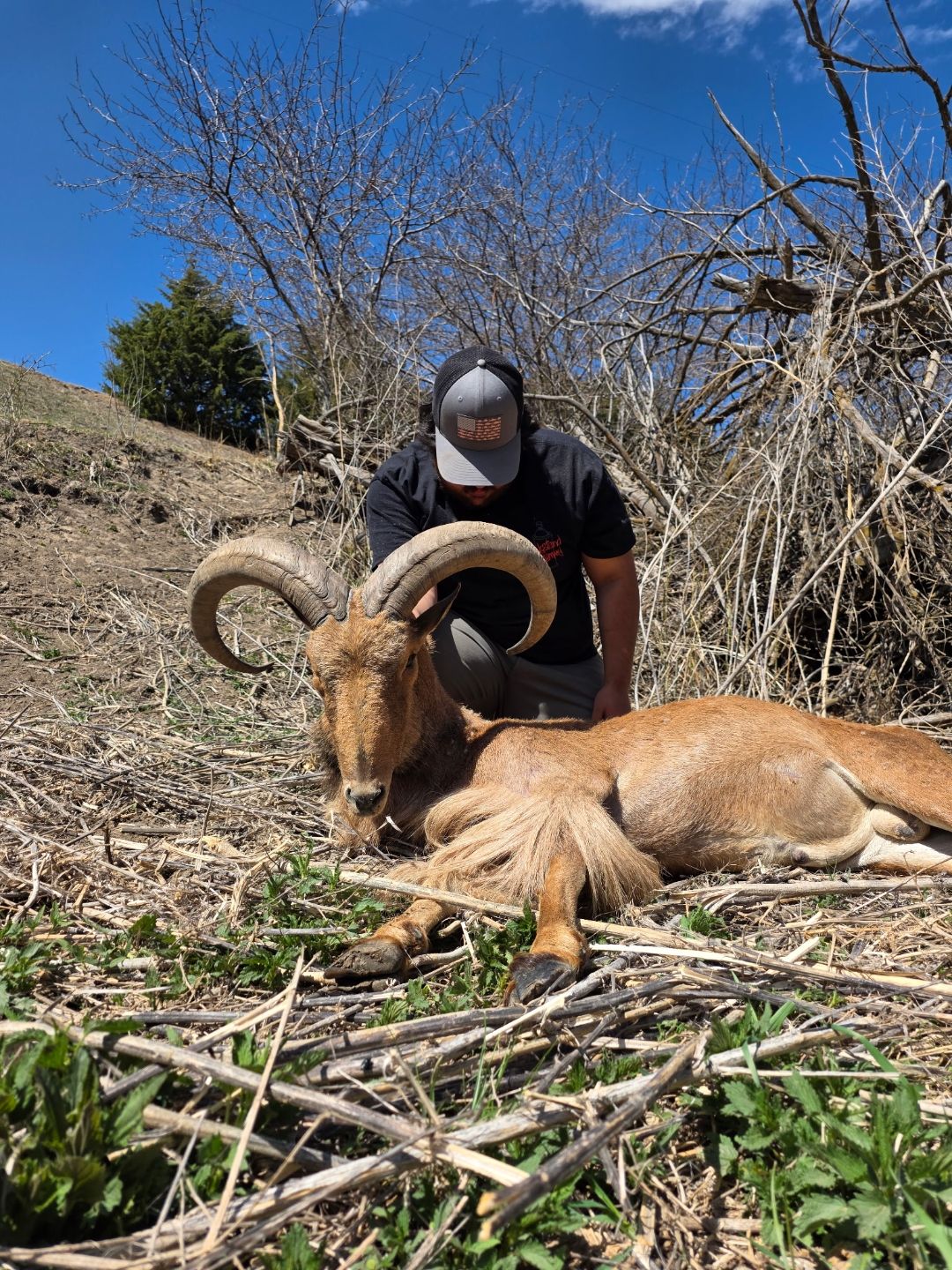
If you've started researching aoudad hunts, you've already noticed the same thing every other hunter notices: it's almost entirely a Texas story. Texas has the most animals, the most outfitters, the most content, and the most well-worn opinions about how an aoudad hunt is supposed to go.
That makes sense. Texas introduced aoudad in 1957 and now has an estimated 100,000 free-roaming animals in the Trans-Pecos alone — more than the entire native aoudad population remaining across all of North Africa. The state has had 70 years to build a hunting industry around them, and it has.
But "Texas dominates the market" and "Texas is the best option for every hunter" are two different statements. They're not the same thing.
We run aoudad hunts here at ReWild Ranch in the Nebraska Sandhills — which makes us one of a very small number of operations offering this hunt outside of Texas. We have a point of view, obviously. But I'm going to try to give you the information you'd want from a friend who's guided both types of hunts, not a sales pitch.
What Texas Does Well
Texas aoudad hunting has legitimate advantages, and I'd rather be straight about them than dismiss them.
The animal density is real. With 100,000-plus animals in the Trans-Pecos region, experienced Texas outfitters can put you on herds reliably. Most reputable operations report success rates of 80–95% on mature rams. Some offer a 100% opportunity guarantee — meaning if you don't see a shootable animal, you hunt again for free. That's confidence backed by animal numbers.
Free-range mountain terrain is a genuine challenge. Spot-and-stalk hunting in the Chinati Mountains, the Glass Mountains, or the Davis Mountains is the real thing. You're glassing miles of rocky canyon country at 4,000–6,000 feet, reading terrain for a herd that doesn't want to be found, and making shots in the 200–400 yard range on moving animals. If you want a physically demanding, mountain-style hunting experience, West Texas has it.
Trophy quality is established. The gene pool of Texas aoudad has been developing for 70 years on large private ranches. Average horn length on mature rams runs around 29 inches; 30-plus-inch animals are achievable at reputable operations, and exceptional rams in the 34–36 inch range exist at premium properties.
Season flexibility is maximum. No closed season, no tag, no draw — Texas private-land aoudad are year-round. That's genuinely hard to beat for scheduling flexibility.
Where Texas Hunting Gets Complicated
The same factors that make West Texas legendary for aoudad hunting also create real friction for a lot of hunters. These aren't invented objections — they come up in every forum thread where hunters compare notes after their first Texas aoudad trip.
The terrain is punishing. West Texas free-range aoudad hunting is rated strenuous by almost every outfitter who's honest about it. You're hiking at 3,500–6,500 feet elevation over sharp shale rock, through thorned desert vegetation, often in 20-to-70-degree temperature swings in a single day. Every serious West Texas guide will tell you to spend 4–6 months training before you show up. That's not a liability disclaimer — they mean it. Hunters who don't prepare for the physical demands have miserable hunts and often don't fill their tags.
Altitude affects more hunters than they expect. Most of the aoudad hunting in Texas happens at elevations where thin air is a real factor. Hunters from Iowa, Illinois, Minnesota, Indiana, or any flat-state background will notice reduced stamina immediately. Some experience headaches and fatigue for the first day or two. For hunters over 60, or those with any cardiovascular considerations, this is not a minor inconvenience — it can turn a hunt into a real physical ordeal.
Getting there is expensive and inconvenient. El Paso and Midland are the gateway airports for West Texas hunting. If you're coming from east of the Mississippi, you're routing through Dallas or Houston, paying for a connecting flight, renting a truck, and driving 2–4 hours to the ranch. Round trip airfare plus a rental vehicle can easily add $1,200–$2,500 to your total trip cost before you've paid the outfitter a dime.
Pricing adds up fast. The standard Texas model — trophy fee plus day rate — isn't deceptive, but it's easy to underestimate. A trophy fee of $3,950–$5,500 plus $450–$750 per night for lodging, plus processing fees, puts most quality hunts at $5,500–$8,000. Add your travel costs and it's not unusual to be at $9,000–$11,000 all-in for a West Texas aoudad hunt. That's a legitimate number for a legitimate experience — but it needs to be in your budget, not discovered after you've booked.
The conservation situation is changing. In June 2025, Texas legislators legalized aerial hunting of aoudad — adding them to the very short list of animals that can be shot from helicopters. Big Bend National Park has begun aerial removal operations to eliminate aoudad from the park. The Wild Sheep Foundation has taken a position against promoting aoudad hunting in their publications and events, citing catastrophic impacts on the Texas desert bighorn sheep recovery program. Texas's wild desert bighorn population has dropped from roughly 1,800 animals to approximately 400 — down 78% — largely due to competition from aoudad, which can carry pneumonia bacteria that kills bighorn but doesn't affect them.
None of this makes a Texas aoudad hunt unethical or illegal — on private land, far from bighorn habitat, it's still a straightforward hunt for an introduced exotic species. But it's worth understanding the context you're stepping into.
What Nebraska Offers
We don't have 100,000 aoudad in the Sandhills. We're not going to pretend otherwise. What we have is a genuinely different hunting experience that serves a specific type of hunter very well.
The terrain is accessible without being easy. The Nebraska Sandhills are rolling grass-stabilized sand dunes — some of them rise 300 to 400 feet — with cedar draws, native grassland, and open prairie. Elevation runs around 2,000 to 2,500 feet above sea level. There's no altitude to acclimate to. The footing is soft sand and native grass rather than sharp shale and cactus. You're still covering ground, still reading terrain, still glassing — but you're doing it without the physical punishment of mountain country at altitude.
For hunters over 55, hunters from flat-state backgrounds who haven't built altitude tolerance, or hunters who want a real hunt without the brutality of Trans-Pecos terrain, that's a meaningful difference. It's the mountain-style experience of spot-and-stalk hunting for a challenging, hard-to-pattern animal — without the mountain.
We also offer blind setups for hunters who need a mobility accommodation. Not every hunter can cover miles of rolling prairie on foot. We don't think that should keep you from going home with an aoudad.
No conservation conflict. Nebraska does not have a wild bighorn sheep population in the Sandhills. The aoudad at ReWild Ranch are privately-owned exotic livestock on private land — there is no invasive species conflict, no competing native ungulate population, no political controversy. You're hunting an exotic species on a managed private ranch, full stop. If that simplicity matters to you, it's real here.
The lodge is not an afterthought. Many West Texas operations are working ranches with functional but basic accommodations. Our lodge is 8,500 square feet. Meals are farm-to-table — not sandwiches from a cooler in a truck. If you're spending multiple days at a hunting camp, where you sleep and what you eat matters to the quality of the experience. That's not luxury for luxury's sake; it's recognition that the hunt starts the night before and ends the night after.
All-inclusive pricing. Our pricing structure covers lodging, meals, guiding, and field processing in a single number. You know what you're spending before you book. There's no trophy fee plus day rate plus processing plus extra night charge. When you do an honest comparison of total trip cost — including travel, since most of our hunters can drive in from the Midwest and Plains states — Nebraska often comes in favorably against what a comparably quality Texas hunt costs all-in.
Availability is open. Texas aoudad hunting at reputable operations has become competitive. Good outfitters book out months in advance, particularly for fall and early winter dates. Nebraska aoudad hunting is genuinely under the radar — we don't have a 12-month wait list, and we're not overbooked. That's partly because most hunters don't know Nebraska aoudad hunts exist. We're happy to keep that conversation going.
INTERNAL LINK: Aoudad Hunting in Nebraska: Why Hunters Are Skipping Texas
Honest Side-by-Side Comparison
| Factor | West Texas | ReWild Ranch, Nebraska |
|---|---|---|
| Animal population | ~100,000 free-ranging in Trans-Pecos | Managed private herd |
| Terrain | Rocky desert mountains, 3,500–6,500 ft | Rolling Sandhills grassland, ~2,000 ft |
| Physical demand | Strenuous; altitude is a factor | Moderate; no altitude issues |
| Travel logistics | Fly to El Paso or Midland; 2–4 hr drive | Drive-in friendly from Midwest/Plains |
| Pricing structure | Trophy fee + day rate + processing | All-inclusive |
| Typical total trip cost | $7,000–$11,000+ with travel | Lower all-in, especially for drive-in hunters |
| Lodge quality | Varies widely; basic to luxury | 8,500 sq ft, farm-to-table meals |
| Conservation context | Bighorn sheep conflict; aerial hunting legalized 2025 | No native species conflict |
| Availability | Quality dates book out months ahead | Under the radar; availability open |
| Hunt methods | Spot-and-stalk dominant | Spot-and-stalk + blind option |
| Combo hunt options | Sometimes | Yes — bison, elk, whitetail, turkey on same property |
Who Should Book Texas
If you're a physically fit hunter with mountain experience, you've already got time and training behind you, and you want the most challenging aoudad hunt available — West Texas free-range spot-and-stalk is the right choice. The terrain demands respect. The experience earns it. If a 30-plus-inch free-range ram in the Trans-Pecos is your goal and you're prepared to earn it on foot at altitude, Texas is the right call.
Who Should Consider Nebraska
If you're east of the Mississippi and don't want to deal with two-flight logistics and a truck rental. If you're 55 or older and altitude is a real consideration. If you've had a knee surgery, a hip replacement, or any other issue that makes rocky mountain terrain risky rather than challenging. If you want to combine an aoudad hunt with bison, elk, or whitetail on the same trip. If you want to know the full price before you book. If you want an 8,500-square-foot lodge with real food instead of a bunkhouse. If you want to talk to Danielle and have someone give you a straight answer about what the hunt is and what it costs.
Nebraska isn't trying to be Texas. We're offering something different — and for the right hunter, it's the better fit.
Frequently Asked Questions
Q: Do I need any special permits or licenses to hunt aoudad in Nebraska?
No. Because aoudad at ReWild Ranch are privately-owned exotic livestock on private land, Nebraska does not require a state hunting license or any special permit. This is one of the practical advantages of hunting an introduced exotic on private land rather than a state-managed wild game species.
Q: Is the aoudad hunting experience in Nebraska comparable in quality to Texas?
The experience is different, not lesser. Texas offers a wilder, more physically demanding mountain environment. Nebraska offers a genuine spot-and-stalk hunt for the same species in terrain that's accessible to a broader range of hunters. Trophy quality depends on the specific animals managed at each operation; contact us directly to discuss what's available. The service, lodging, and meal quality at ReWild Ranch is objectively higher than what most Texas operations at a comparable price point provide.
Q: Why are Nebraska aoudad hunts so hard to find information about?
Because until recently, almost no one was marketing them. ReWild Ranch is one of the only operations in Nebraska offering guided aoudad hunts, and most hunters simply don't know the option exists. Search results for aoudad hunting are dominated by Texas content because Texas has been doing it for 70 years and has dozens of outfitters publishing content. We're working on that.
Ready to find out if a Nebraska aoudad hunt is the right fit for you? Contact Danielle at ReWild Ranch to discuss availability, what the hunt looks like, and what it costs — all in one conversation, no runaround. Reach us at rewildranch.com or call (308) 730-4116.
check out other posts
Nebraska Sandhills Lodge: Where to Stay When You're Not Hunting
Buffalo Hunts: What a Real Guided Hunt Looks Like in 2026
