BLOG
Thermal and Night Vision Coyote Hunting in the Nebraska Sandhills
Thermal and Night Vision Coyote Hunting in the Nebraska Sandhills
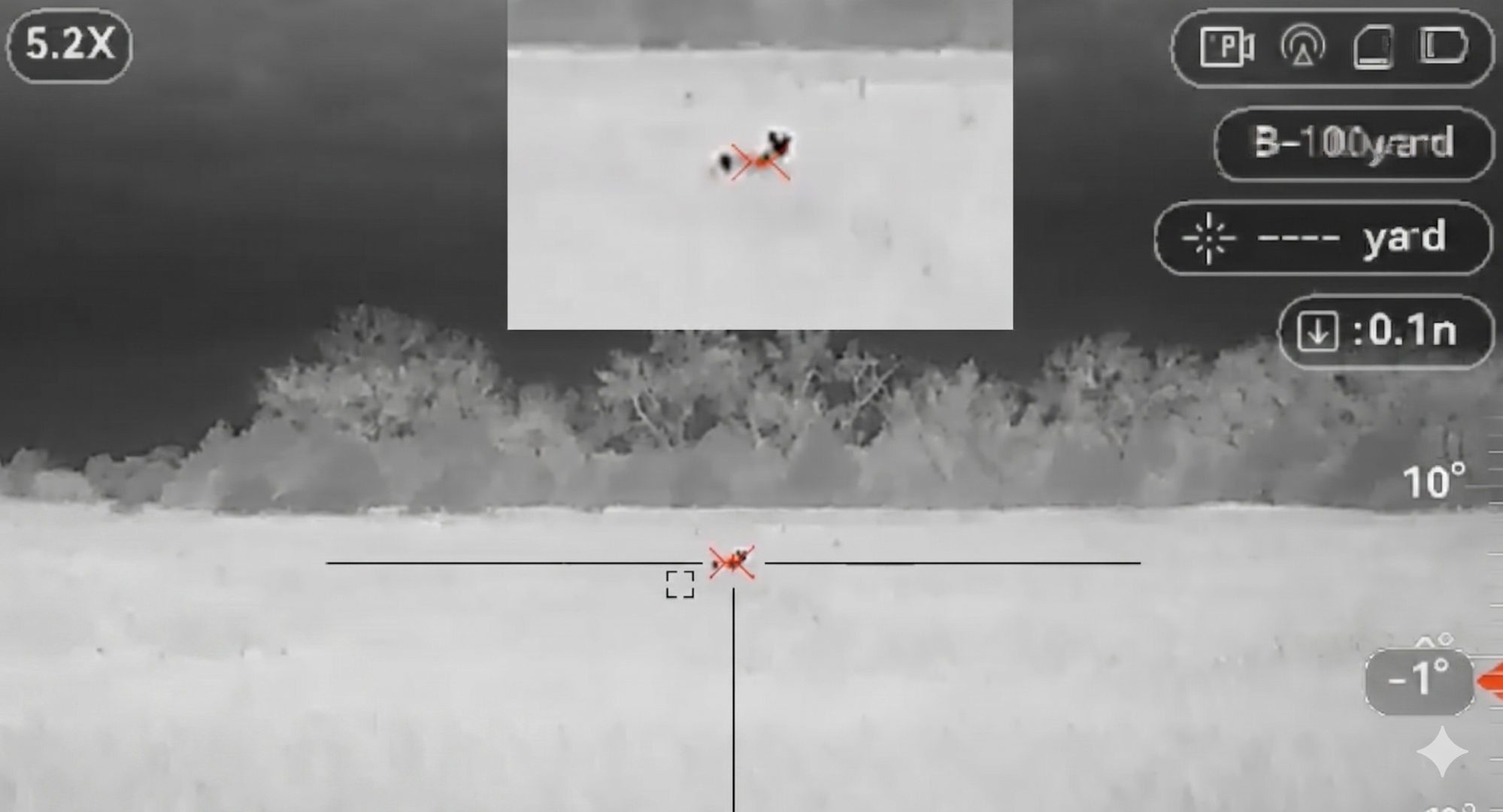
Thermal coyote hunting in the Nebraska Sandhills is one of those experiences that changes the way you think about predator hunting. You set up on a hillside with open rolling grass country in every direction, start the e-caller, and within minutes you're watching a heat signature — glowing orange against a cool black background — materialize out of the dark at 400 yards and work its way toward the sound. The terrain here is built for this kind of hunting.
We've been running thermal and night vision hunts here at ReWild Ranch in Sargent, Nebraska for years. Our working bison ranch in Custer County sits in the middle of Sandhills country, and the combination of open sightlines, high coyote density, and the legal framework Nebraska provides for thermal equipment on private land makes for some of the best night hunting anywhere in the region.
Nebraska law explicitly permits both thermal scopes and night vision devices for coyote hunting. The NGPC Furbearers page states directly: "Electronic predator calls and thermal scopes are allowed when hunting coyotes." Night hunting on private land with landowner permission is fully legal — which means everything we run on our deeded ground is by the book. For a full breakdown of the regulations, see our Nebraska coyote hunting regulations guide.
Thermal vs. Night Vision: Which Is Better for Coyotes?
This question comes up on every hunt consultation. The short answer: thermal wins for coyote hunting, and it's not particularly close.
Here's why:
| Thermal | Night Vision (Digital) | |
|---|---|---|
| Works in total darkness | Yes — detects heat, no light needed | No — requires ambient light or IR illuminator |
| Detection range | 500–2,000+ yards (quality units) | 100–400 yards typical |
| Performance in fog or rain | Yes | No |
| Target ID detail | Lower — silhouette/heat signature | Higher — more natural image |
| Species identification | Harder at distance | Easier at close range |
| Entry-level price | ~$900 (ATN Thor LT) | ~$300–600 |
| Best for open prairie | Yes | No |
In the Sandhills, where you might be watching a half-mile of open grass, thermal is the only tool that gives you reliable detection at the distances coyotes can approach from. A coyote trotting across a grass meadow at 400 yards is invisible to night vision in that terrain. On thermal, it glows like a lit match against the dark background — especially on cold nights when contrast between the animal's body heat and the cool ground is at its peak.
Cold weather dramatically improves thermal performance. Below 30°F, the image quality on a quality thermal scope is exceptional. The Nebraska Sandhills in December and January delivers exactly those conditions.
Night vision has its place — it's less expensive, and it produces a clearer, more natural image at close range when something is close enough that you need to confirm species before the shot. Some serious hunters run both: a thermal monocular in one hand for detection and a night vision scope on the rifle for shot execution under 150 yards. But if you're choosing one tool for open Sandhills coyote hunting, thermal is the answer.
Equipment We Provide and What to Bring
What ReWild Ranch Supplies
Our guided predator hunts include thermal and night vision equipment. Guests are not required to bring optics for the night portion of the hunt — our guides carry the gear and operate it during guided stands.
We run Pulsar Thermion thermal riflescopes on our guided night hunts. The Thermion platform is purpose-built for predator hunting — it mounts to a standard rifle and replaces the day scope during night stands. In open Sandhills terrain, the Thermion's detection range well exceeds 500 yards for an animal the size of a coyote, which is roughly the distance at which Sandhills stands become meaningful. Cold temperatures on a clear Nebraska December or January night push effective detection even further.
We also use handheld thermal monoculars for scanning — specifically for the pre-stand sweep before we start calling and for continuous scanning while the caller runs. The combination of a handheld thermal for detection and a thermal riflescope for shot execution is how our guides run a stand.
What Hunters Should Bring
- Your rifle — chambered in whatever you shoot accurately. We recommend .22-250 or .223 for the Sandhills. The thermal scope goes on our guide's rifle; if you want to shoot with your own rifle, bring a quality day scope (we run day and night stands).
- Warm layered clothing — Night stands in January in the Sandhills run cold. We're talking 10–25°F with wind. Dress like it matters, because it does.
- Wind-resistant outer layer — The Sandhills has a persistent breeze. A windproof shell over your base layers makes a substantial difference in comfort and focus on a 2-hour night stand.
- Good boots — Waterproof and insulated. You'll be walking through grass and potentially frozen ground to reach stands.
If you hunt with your own thermal equipment, that's welcome. Some clients bring their own Pulsar, ATN, or Trijicon units and hunt with our guides as the callers and spotters. We'll coordinate the setup either way.
How the Sandhills Terrain Changes Night Hunting Strategy
The Nebraska Sandhills is fundamentally different terrain from the wooded creek bottoms and field edges where most predator hunters learned their craft. Here, you have:
- Rolling grass hills with open meadows between them
- Draws and marshes in the low ground — where the coyotes actually live
- Sight lines of 500–800 yards to the next ridgeline
- Few trees, minimal vertical cover, constant wind
That terrain changes how you set up, how far you position the caller, and how long you stay on a stand.
The biggest advantage: You can see everything coming. A coyote responding to the call from 600 yards is visible on thermal long before it reaches your position. You have time to get the rifle up, settle in, and watch the approach rather than being surprised at 40 yards.
The biggest challenge: Coyotes can see you from as far as you can see them. Silhouetting yourself against the skyline on a Sandhills ridgeline will burn a stand before you start calling. We set up with our backs to the ridge, facing the bowl below, so our outline is below the crest — not on it.
The draws and marshes between the hills are where coyotes concentrate. That's where the rodents are, where whitetail deer and waterfowl use the water, and where the food supply is densest. Our best night stands position the e-caller down in the bottom of a bowl or at the edge of a marsh, with our shooting position slightly elevated above — enough to see over the grass, not enough to break the skyline.
In flat or lightly rolling terrain with a quality thermal scope, coyotes are detectable at 500+ yards. A Pulsar Thermion 2 LRF XG60 — which we've run on our guided hunts — will reliably detect a coyote-sized heat signature at distances well beyond that in cold, clear conditions. The built-in laser rangefinder is invaluable in featureless terrain where estimating distance without reference points is genuinely difficult.
The Scan-and-Shoot Technique for Night Coyote Hunting
Running a successful thermal night stand isn't just about equipment — it's about discipline and sequence. Here's how we run ours:
Step 1: Pre-stand sweep. Before starting the e-caller, sit for 2–3 minutes in complete silence. Do a full 360-degree scan with the handheld thermal monocular at low magnification. You're looking for coyotes that may already be in the area — animals that were moving when you arrived. We've called off stands because we spotted coyotes while setting up the caller, then adjusted our position to intercept them.
Step 2: Start calling and scan continuously. Once the caller starts, sweep in slow, deliberate 5-degree increments with a 3–5 second pause per sector. Don't hurry. Coyotes that respond to the call from a distance may cover ground at 10 mph — that's a mile in 6 minutes — but they also may approach at a trot and stop repeatedly to scan. Continuous sweeping catches them at any point in the approach.
Step 3: Detection protocol. At 200+ yards in cold conditions, a coyote on thermal is a bright, distinct heat shape moving against cool grass. Don't overthink identification at distance — look for moving heat signatures. Once spotted, watch the approach angle and identify the downwind flank. Coyotes almost always circle to approach from downwind in the last 100–150 yards.
Step 4: Transition to shot. When a coyote commits to the approach and enters shooting range, reduce the caller or silence it. This keeps the animal focused on a fixed point without the audio stimulus alerting it to the silence change in your position. Stay still. The shot opportunity typically comes when the coyote pauses at 50–100 yards to look at the caller.
Step 5: Post-shot scan. After every shot, immediately sweep 360 degrees with the handheld thermal. Coyotes trailing behind the first animal will often hold for 10–30 seconds before flushing. Many of our best nights have produced a second (or third) animal right after the first shot — because we were already scanning.
Night Stand Setup: Timing and Wind
Wind management matters at night just as it does in daylight, but the open Sandhills adds a layer of complexity: thermals. As the ground cools after sunset, air flows downhill from the ridgetops into the draws. That means your scent is moving into the low ground — right where the coyotes are. We account for this by setting up with a crosswind where possible, so the scent cone runs across the terrain rather than directly into the primary approach corridor.
Best activity windows for night coyote hunting in the Sandhills:
- Dusk through 9 p.m.: Moderate activity. Good for early-season hunters or when temperatures are dropping. Coyotes moving from bedding areas to hunting corridors.
- 9 p.m. to 1 a.m.: High activity. This is the sweet spot — coyotes are active, responsive to calls, and moving freely. Our most productive night stands happen in this window.
- 1 a.m. to 3 a.m.: Peak activity, especially in winter. Coyotes have been hunting for hours and are more focused on food sources. Patience and good stand selection matter most here.
- Pre-dawn (3–6 a.m.): Declining activity. Still productive, especially near food sources. Worth running if you're already out.
Night stands run longer than daytime stands. We typically sit 20–30 minutes per night stand with 30–45 second call bursts separated by 3–5 minute silences. The longer intervals give coyotes time to travel in the dark — they need more time to locate the sound and work toward it without the visual confirmation daylight provides.
Winter vs. Summer Night Hunting
Both seasons produce, but they produce differently.
Winter (November–March) is the peak season for thermal night hunting at ReWild Ranch. Cold temperatures maximize thermal contrast. Coyotes are more active during daylight and concentrated by hunger in predictable corridors. The breeding season (January–March) makes them aggressive and fast to respond. Fur is prime if that matters to you.
Summer (June–August) is where most hunters don't bother, but it's worth reconsidering. The Sandhills holds large numbers of coyotes year-round, and pup distress calls in June through August produce fast, committed responses from adult coyotes in parental mode. Summer nights are warm, which reduces thermal contrast — you won't get the same 600-yard detection you get in January. But coyotes are still visible at 200–300 yards, and pup-year coyotes are naive enough to come in without the hesitation that educated winter coyotes display.
Summer hunting at ReWild also ties directly to bison calf protection. Our calving season runs spring through early summer, and coyotes that learn to target calves are a real threat to the ranch operation. Night hunting in summer is as much ranch management as it is recreation.
For a full breakdown of year-round coyote activity and the case for summer hunting, see our guided predator hunting Nebraska hub.
Book Your Hunt
Our 2-day/3-night all-inclusive predator hunts run $1,795 per hunter. Thermal and night vision equipment is included — you don't need to own a thermal scope to experience what night hunting in the Sandhills looks like. Lodging, home-cooked meals, and guide are included. Coyote year-round, bobcat December through February, badger November through February — no trophy fees on any of them.
Call Danielle at (308) 730-4116 to check open dates. ReWild Ranch is located at 81785 Road 457, Sargent, Nebraska 68874.
For our approach to e-caller strategy on these same stands — what sounds we run, when we switch from distress to howls, and how we sequence the night stands — see: Electronic Call Strategy for Coyotes: How to Work the Sandhills Prairie.
Frequently Asked Questions
What thermal and night-vision equipment does the ranch supply, and what should hunters bring?
ReWild Ranch provides Pulsar Thermion thermal riflescopes and handheld thermal monoculars for guided night hunts — guests are not required to bring their own optics. Hunters should bring their own rifle (chambered in .22-250, .223, or similar), warm layered clothing rated for 10–25°F with wind, waterproof insulated boots, and a windproof outer shell. Hunters who own their own thermal or night vision equipment are welcome to use it; our guides serve as callers and spotters in that case.
How does the open Sandhills terrain change calling strategy for night coyote hunting?
Open rolling terrain with long sight lines — typical of the Sandhills — means you can detect incoming coyotes at 500+ yards on thermal, giving you time to prepare for the shot instead of being surprised at close range. It also means coyotes can see your silhouette from the same distance, so setup position matters: stay below the ridgeline, never skyline yourself, and position the e-caller 30–50 yards out in the bowl below your shooting position. Night stands in open country run 20–30 minutes minimum, with 30–45 second call bursts and 3–5 minute silent intervals to allow time for distant coyotes to travel in.
What time of year produces the highest coyote density and calling success in the Sandhills?
Winter — December through February — produces the highest calling success at ReWild Ranch. Cold temperatures maximize thermal contrast, coyotes are more active and hunger-driven, and the January–March breeding season makes them aggressive and fast to respond to calls. Summer (June–August) produces the second-best window: pup distress calls draw fast, committed responses from adult coyotes in parental mode, and young-of-year coyotes are naive and responsive. Spring (April–May) tends to be the slowest period for reactive calling, though territorial howling near den sites can produce results.
check out other posts
Nebraska Sandhills Lodge: Where to Stay When You're Not Hunting
Buffalo Hunts: What a Real Guided Hunt Looks Like in 2026
